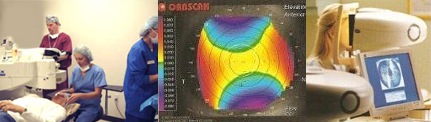
| Eyeglasses and contact lenses are the most common method of treating
nearsightedness, farsightedness and astigmatism. With new technological
advances, we offer a variety of vision improving procedures, including
Custom LASIK, LASEK, PRK, CK and Phakic IOL’s. We offer a complimentary
refractive evaluation and Dr Konowal will discuss various options for eliminating
dependence on glasses or contact lenses.
BLADE FREE CUSTOM LASIK
LASIK (Laser Assisted In Situ Keratomileusis) is a laser corrective procedure that has been performed on over 40 million people worldwide. Since its FDA approval in 1995, the procedure has improved with advances including blade-free technology and “custom” treatment platforms.
LASIK has been proven to be safe and effective in reducing a range of refractive errors up to 12 D of myopia, 6 diopters of hyperopia and 6 diopters of astigmatism. Blade –Free LASIK is a computer-guided laser used during the first step of the LASIK procedure to create a micro-thin corneal flap. The flap is lifted to expose the inner cornea in order to perform the second step of the laser procedure, which corrects your vision. The IntraLASE® FS Laser System is now available and virtually eliminates almost all the most severe, sight-threatening complications associated with the LASIK procedure. The femtosecond laser creates a flap in 15 seconds with improved safety, precision and micron-level accuracy. Combining the safety of the IntraLASE® FS Laser System with the accuracy of the ZYOPTIX™ Custom Laser Treatment has given patients excellent vision through state-of the-art technology.
The Bausch & Lomb ZYOPTIX™ laser treatment involves technology that provides a complete analysis of the eye’s optical system. The ZYWAVE II Aberrometer is a precision optical instrument that measures the wavefront of the entire optical system with a three-dimensional map of the eye. By combining the mapping of the cornea with the wavefront of the entire eye, the ZYOPTIX™ system maps up to 9,600 data points, giving the surgeon a precise, personalized treatment plan. This personalized laser vision system has been shown to improve uncorrected vision to better than 20/20 in greater than 90% of patients treated in the U.S. Clinical Trials. In fact, in the U.S. clinical trials not a single ZYOPTIX™ patient was dissatisfied with the results of surgery. Patients reported “extreme” improvement in the quality of their vision, with no increase in glare, halos or night driving difficulty. By combining the safety of the IntraLASE® FS Laser System with the accuracy of the ZYOPTIX™ Custom Laser Treatment patients can achieve excellent vision through state-of the-art technology.
 Good candidates for LASIK must have healthy eyes, with a stable prescription for the past year. Individuals over 40 who suffer from presbyopia may still require reading glasses for near work, or may choose to undergo MONOVISION treatment.
The surgery is performed with minimal discomfort. There are no stitches or eye patches and patients experience quick recovery and can resume normal work activities by the next day. If you have been waiting for safe technology to correct your eyes permanently, the Intralase combined with the B & L Zyoptix personalized laser vision correction system can do more than improve your vision, it can enhance your life.
ADVANCED SURFACE ABLATION
Laser surface ablations are alternative laser refractive treatments for individuals who are not LASIK candidates. The excimer laser is used to remove microscopic amount of tissue guided by the ZYOPTIX™ system. Myopia, hyperopia, presbyopia and astigmatism can be treated with a high degree of accuracy. This technique eliminates the need for a corneal cap, and is indicated for patients with thin or irregular corneas, corneal dystrophies or for those who engage in activities where they are predisposed to eye trauma. Although complete healing and stabilization of vision can take as long as a month with this procedure, excellent results are obtained with the Custom ZYOPTIX™ treatments.
PRK/LASEK
Photorefractive Keratectomy (PRK) and Laser Epithelial Keratomileusis
(LASEK) are alternative laser vision correction procedures. They are
a better choice for patients who have basement membrane dystrophy,
orbital anatomy precluding the safe and effective use of a microkeratome,
flat corneas, thin corneas, or professions or lifestyles that predispose
them to trauma. Similarly to LASIK, the laser is used to remove microscopic
amounts of tissue, measured in microns on the surface of the cornea,
rather than underneath a cap. After a few days a new layer of surface
cells grows. A bandage lens is used to aid in healing and to minimize
discomfort during the healing time. Complete healing and stabilization
of vision can take as long as a month with these procedures, but excellent
results are obtained and Custom treatments are available for these
procedures also.
NEAR VISION CK
Presbyopia (Greek for the “aging eye”) is
America’s most prevalent condition. 90 million people either have
presbyopia or will develop it in the next ten years. The condition causes
near vision to fade with age, affecting most people by the age of 40
and everyone by the age of 51.
Conductive Keratoplasty (CK), approved by the FDA in April of 2002, is
the fastest growing refractive procedure since LASIK, and is a welcomed
alternative for baby boomers with presbyopic symptoms to improve near
vision. Conductive Keratoplasty is designed for people ages 40 and over
who use glasses or contact lenses for reading or computer work, but who
otherwise have good distance vision. Criteria for Conductive Keratoplasty
are being over 40 years old with good distance vision, no chronic eye
disorders, not pregnant or nursing and no chronic illness.
CK is a noninvasive technique which uses radiofrequency energy to gently
reshape the cornea. This is accomplished without cutting or removal of
tissue. During a quick in-office procedure, Dr. Konowal uses a probe
as thin as a human hair to apply radiofrequency energy around the edge
of the cornea. By steepening the curvature, the cornea can bend light
rays to bring near objects into focus directly on the retina.
CK is typically performed on just one eye, improving near vision in
most cases without compromising the patient’s ability to see far
away (binocular distance vision). Patients experience quick recovery
and instant results. With CK, farsighted patients are less likely to
experience side effects that are common in LASIK, such as poor night
vision, glare, blurriness and dry eyes (a particular problem among menopausal
women who have laser vision correction).
If you are experiencing problems with your near vision and meet the
above criteria, Konowal Vision Center offers a free refractive evaluation
to assess whether NearVision CK is right for you.
Phakic IOL’s
The term “Phakic IOL” means an artificial
lens is implanted inside the eye, leaving the eye’s natural lens
in place. Some of the IOL’s (intraocular lenses) are implanted
in front of the iris (the colored part of the eye) and some behind the
iris. The implantation of a phakic IOL is done as an outpatient procedure
in an ambulatory surgery center under topical anesthesia. Most patients
experience little to no discomfort during the actual procedure, and report
an instantaneous, dramatic improvement in their vision, similar to LASIK.
The Verisyse™ IOL was the first phakic IOL to receive FDA approval.
It is approved for the reduction or elimination of nearsightedness ranging
from –5.00 D to –20.00 D. This is well beyond the range of
LASIK, which is approved to treat up to –14.00 D. The Verisyse™ lens
is made of polymethylmethacylate (PMMA, a type of plastic), and is placed
in front of the iris. The lens design has been used in Europe for nearly
two decades. In that time, more than 150,000 phakic refractive procedure
have been performed using the Verisyse™ design. The implant has
shown excellent stability of vision over time, and a very high degree
of predictability. In the FDA clinical studies, 47% of eyes saw 20/20
or better uncorrected, and 93.6% saw 20/40 or better uncorrected.
The Visian ICL is a phakic intraocular lens which is placed behind the
iris, in front of the natural lens of the eye. The Visian lens is capable
of correcting from –3.00 D to –20.00 D of nearsightedness.
It is made of collamer, a co-polymer that contains a small amount of
purified collagen. It is very biocompatible and stable. It also contains
an ultraviolet light filter. The soft, flexible nature of the Visian
ICL allows it to be injected into the eye through a very small incision,
requiring no stitches. Over 35,000 ICL’s have been implanted worldwide.
In the FDA clinical studies, 59% of eyes had 20/20 or better uncorrected
vision and 95% had 20/40 or better uncorrected. Learn more.
Refractive Surgery FAQ’s
What does the refractive evaluation involve?
At the initial exam, Dr. Konowal will perform a thorough dilated examination
and study your health, lifestyles, activities and any special vision
needs you may have. Measurements will be taken that are specific to vision
correction, such as topography (mapping of the cornea), and an ultrasound
measurement to determine the thickness of your cornea. In addition your
pupil size will be measured to determine if you will be bothered by night
glare and halos. Dr. Konowal will also discuss with you the various options
for surgery, which procedure would be best, how to eliminate reading
glasses and what to expect after surgery.
If you are wearing contact lenses, it is necessary to remove those lenses
prior to this initial examination. Contact lenses must be removed 3-5
days prior to this appointment to allow your cornea to return to its
normal shape. If this is a challenge before your first visit, you may
make your first appointment only to meet with Dr. Konowal and discuss
surgery options.
Can you briefly explain
what a patient should expect during a procedure?
You will be instructed to take a mild sedative one hour prior to arriving
at Konowal Vision Center for your corrective procedure. If you are
scheduled for a Custom LASIK procedure, a Wavescan® analyzer measurement
will be taken of your eyes. This is a map of the unique characteristics
of your optical aberrations. This measurement will be linked to the
VISX STAR S4™ to allow the laser to
resculpt the cornea to correct your nearsightedness, farsightedness,
astigmatism and optical irregularities. You are in the surgical suite
for about 10 minutes, however, the procedure takes only a few minutes
per eye. After your procedure, you will be escorted to an exam room,
where Dr. Konowal will re-exam the operated eyes and review your after
care.
What should I expect
when I go home?
We instruct our patients to rest when returning home. Vision will
be blurry for the first 24 hours, but most people can resume normal
activity the next day (including driving a car). It is important to
avoid dusty, dirty environments and avoid getting water in the eyes
for two weeks. If your procedure was PRK, LASIK, or CK, we will use
the same protocol as indicated above. Discomfort is minimal during
recovery, although it is normal to experience scratchiness and fluctuating
vision for a few days. Patients who have PRK performed may find it
necessary to take a pain pill during the first 24 hours.
What medications are used
and for how long following a vision correction procedure?
Dr. Konowal will dispense a topical antibiotic drop for you to use
4 times per day for the week following your procedure. Additionally,
you will use an anti-inflammatory drop. Over the counter lubricating
drops are recommended for six months after surgery to aid in healing.
If a patient is not compliant with the use of drops or has severe dry
eyes Dr. Konowal may recommend the use of a punctal plug inserted in
each tear duct to aid in recovery.
What results should
I expect from Vision Correction?
While the standard for excellence
in vision is measured as 20/20, we have the potential to see even better
than 20/20 with the CustomVue™ procedure.
In fact clinical trial studies found that six months after CustomVue™ more
than 74% of study participants saw 20/16 or better. We must be reminded
that in some patients our planned outcome may not be 20/20; since many
patients choose monovision as a method of correcting both near and far
vision. Conventional LASIK is not thought of as an outdated procedure
and is still recommened for many patients. Each individuals
recommendation will be different; depending on lifestyle, occupation
and individual desires.
Is age a factor when considering
vision correction?
We do not offer LASIK to anyone under 18 as their eyes may still be
changing. However, there are no upper age liminations. Many seniors,
who have had cataract surgery desire vision correction. With active
lifestyles in Southwest Florida, such as golfing, tennis, fishing and
swimming, people find glasses and contact lenses a nuisance.
Will I need reading glasses?
If you are having vision correction before you are 40 years of age,
it is natural with age to have changes in the lens of the eye, which
causes loss of up close vision. As this occurs you would need to wear
reading glasses or seek LASIK surgery to retreat your non-dominant
eye for better near vision.
If I am over 40 and considering
vision correction do you have some options to minimize the need for reading
glasses?
Monovision is when one eye
is corrected to see well in the distance and the other corrected to focus
up close. Both eyes quickly adjust to
work together. Dr. Konowal may suggest you try this vision in disposable
contact lenses for a few weeks prior to a surgery decision. This allows
you to understand your vision prior to deciding on vision correction.
Can I get rid of monovision
if I do not like it?
If monovision is not working
for you in your daily activities, Dr. Konowal may try correcting you
with contact lenses temporarily to determine
what vision would be better for you. Once this decision is made a re-treatment
would be performed to correct your eye to see distance. You, of course,
then need to wear reading glasses for up close vision.
Can I wear contact lenses
or glasses after surgery?
It is uncommon for someone to need to wear corrective lenses after
surgery. There may be rare occasions when someone who was corrected
with mono-vision may want to be corrected temporarily to 20/20 distance
in both eyes, for instance while driving at night or at an evening
theatre performance.. Then they could have glasses made to correct
the near eye to focus on objects at a distance or wear one contact
lens in their reading eye as another alternative.
What does the fee include
and how much are these procedures?
Our fees are affordable and range between $1,750 to $2,100 per eye.
Our fees include the surgery and follow-up care as needed for one year
following surgery. In addition, any enhancement during the first year
are included in the initial fee with the exception of a $110.00 per
eye charge for a laser card to operate the VISX STAR S4™ laser.
LASIK Complications
LASIK does not weaken or scar the cornea, and the long-term results are expected
to be stable. There has never been a reported case of blindness associated
with these procedures. Complications of any kind are rare in the hands of
an experienced surgeon such as Dr. Konowal. There is a less than 1% risk
of serious, vision threatening problems. However, risk of infection cannot
be ignored and is monitored by Dr. Konowal and controlled by the use of a
topical antibiotic. During the first 3 to 5 days of recovery patients experience
fluctuation in vision, some note that their eyes feel scratchy or sandy and
others just note some blurry vision. These temporary side effects are a result
of the dry eyes associated with LASIK surgery, and are treated with over-the-counter
lubricating drops. Some patients may elect to have punctal plugs inserted
into their tear ducts to help with this condition.
Overcorrection or undercorrection: While less than 7% of Dr. Konowal’s
patients need retreatments, it is important to know that Dr. Konowal
will decide to perform an enhancement when any residual refractive error
has stabilized . If your healing results in overcorrection or undercorrection
a touch-up may be performed.
|